

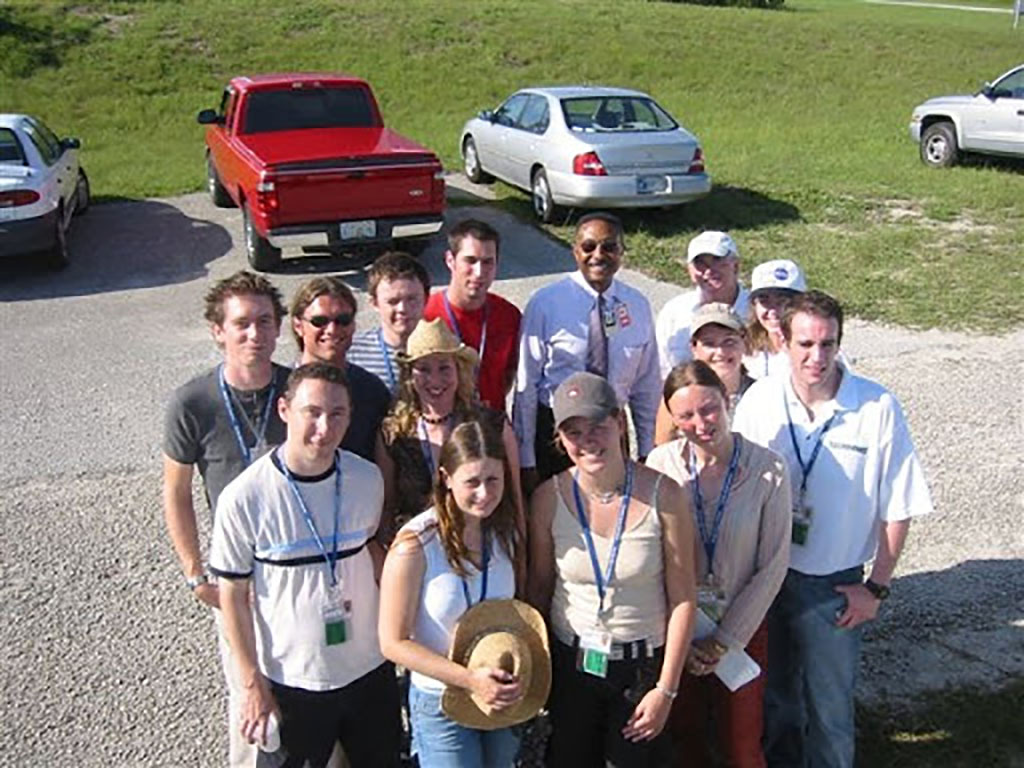
Photo: Capt. Winston Scott at Cape Canaveral’s Launch Complex 47, where these twelve Irish science graduates (collectively known as the Discover Science Program), launched a Super Loki rocket into space in August, 2003.
Video footage seen by NASA engineers the day after launch verified that a suitcase sized piece of insulating foam from Columbia’s External Tank (ET), broke away and struck the left wing. It tore into several reinforced carbon-carbon (RCC) tiles at the leading edge of the Orbiter’s wing thus making safe re-entry into the Earth’s atmosphere virtually impossible. A gaping hole later estimated at between four-six inches in length was the result. This gap in the Orbiter’s wing was sufficient upon Earth’s re-entry to allow temperatures in excess of 3,000 degrees F to enter the wing; to incinerate the sensors, the wiring, the structure and finally the wing itself. The vehicle would quickly break apart. With no means to alter the Orbiter s course to the relative safety of the International Space Station, Columbia and her crew were doomed. However, this news was not passed on to NASA personnel, the media or more importantly to the Columbia crew.
I was curious to know if the Columbia crew had been trained to undertake spacewalks, known in the program as EVA’s (Extra Vehicular Activity). Perhaps they might be able to repair the damage, while on Earth orbit? Terry White, a Shuttle tile expert who worked for thirty-three years at KSC and later retired from United Space Alliance (USA) after the final Space Shuttle flight, spoke to me on this very subject.
“There were EVA suits on board (Columbia) but no plans for an EVA. I do not know how much they trained for an EVA. There were no jet packs (manned maneuvering units) either. NASA astronauts only used those 6 times during the shuttle program and not on STS 107. If they had detected the hole in the wing RCC (Reinforced Carbon Carbon) there was nothing on board that the crew could have used to repair the damage”.
Senior NASA officials in Johnson Space Center (JSC) did not observe any major incidents during the ascent stage and decided not to abort the mission or consider a return to KSC’s Shuttle Landing Facility. This mission abort has never been attempted, although in theory it was considered by NASA to be an option of last choice. To perform a Return To Launch Site (RTLS) abort, the Shuttle would have had to continue downrange until the solid rocket boosters were jettisoned after approximately eight minutes of flight. Columbia would then have to pitch around, so that the Orbiter’s three main engines would fire retrograde. This maneuver would have occurred in a near-vacuum above the appreciable atmosphere being conceptually no different from the Orbital Maneuvering Systems engines firing retrograde in a regular de-orbit. The main engines would have continued burning until downrange velocity was killed and the vehicle began gliding back toward the launch site at sufficient velocity so as to preferably reach the Shuttle Landing Facility (SLF) at Kennedy Space Center. If the decision to abort the mission had been made early, the orbiter Columbia in theory could have made a normal gliding landing on the runway at Kennedy Space Center about 25 minutes after lift-off. But that decision was not made.
It should be noted that the cameras at the Shuttle Launch Pads and throughout KSC were not of sufficient strength at that time to accurately demonstrate the extent of damage that had been inflicted on the Orbiter’s wing during the ascent stages. As observers and being at such a great distance from the launch area, we knew nothing of this catastrophic occurrence. Instead, following the launch, Maureen and I congratulated ourselves on the seemingly successful launch and took pride in the achievements of the American space program.
Following the successful FÁS 2003 Opportunities Fair at Dublin’s RDS, Maureen and I set out for Cork. Fearing what might potentially happen in the U.S. with Columbia and her crew, we wanted to share this moment alone and avoid the media. I purposely timed our drive that by 2.00pm Irish time, we would arrive in the small town of Cashel, County Tipperary. The RTE news bulletin did not mention Columbia, as that was precisely the time in Florida (9AM), when she was scheduled to return home to the Shuttle Landing Facility. The minutes passed by very slowly. Suddenly the scheduled program on the car radio was interrupted by confirmation that Columbia was ‘missing’ over east Texas. Columbia was not missing, it had disintegrated. All seven astronauts on board had perished. I stopped the car abruptly in Cashel and we silently prayed for the astronauts and their families.